The fragility of their nomadic sanctuary was exposed in a single, fragmented evening that pulled them across the social strata of Nutrana.
It began at an upscale gallery opening in the upper terraced district, where Tim had been invited to network with regional architectural clients. He brought the group along under the guise of his “creative team.”
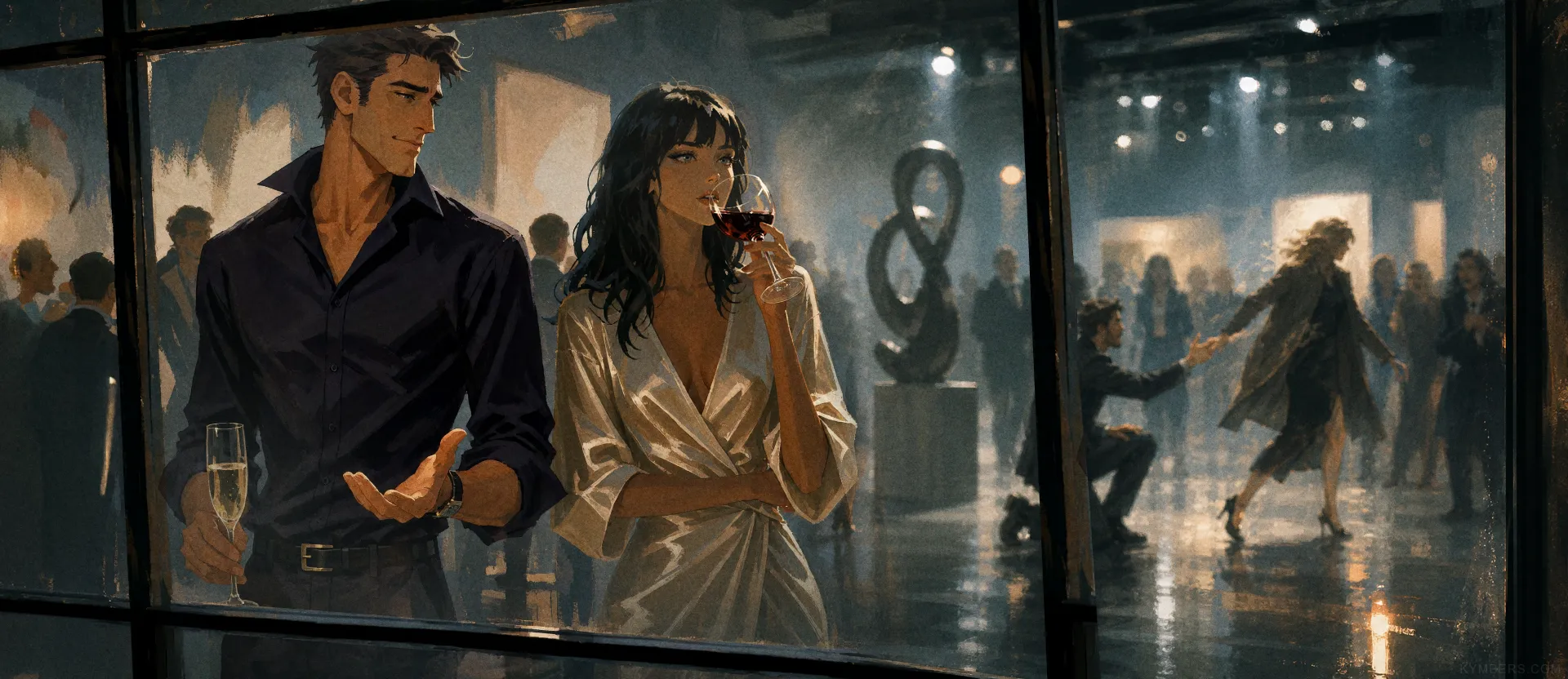
The gallery was a sea of polished concrete, minimalist sculptures, and wealthy patrons sipping vintage champagne.
Tim stood near a floor-to-ceiling window, watching a young couple in tailored evening wear across the room. The man suddenly dropped to one knee, pulling out a velvet box. The surrounding crowd gasped, raising glasses in anticipation—but the woman’s face froze in unmistakable horror. She took two steps back, whispered something sharp that drained the color from the man’s face, and hurried toward the exit, leaving him kneeling alone on the gallery floor amid a suffocating silence.
Tim stared at the rejected man, his sharp blue eyes dark with unresolved tension. He turned to Eva, who was sipping champagne beside him, her long wavy black hair gleaming under the gallery track lighting.
“Is that all marriage is?” Tim asked, his voice thick with half-drunk cynicism. “Just institutionalized fear? Paying for a ceremony so you don’t have to admit you’re terrified of being alone?”
Eva looked at him, her dark eyes unreadable. She swirled the pale wine in her glass. “Marriage is a contract, Tim. People sign contracts when they don’t trust the market. Don’t look for poetry where there’s only risk management.”
She walked away before he could answer, leaving the space between them cold.
Across the gallery floor, May was examining a minimalist linen canvas when a woman in a silk trench coat stopped dead in her tracks.
“May?” the woman asked loudly. “May Linwood?”
May froze. Her bright smile faltered for a fraction of a second before snapping back into place. “Eleanor! What an incredible surprise!”
“I didn’t know you were in Nutrana,” the woman said, looking May up and down with polite amusement. “Did the department store transfer you? I was on the third floor last week and someone said you were out sick from the sweater department.”
The word sweater department seemed to hang in the air like a siren. Nearby patrons glanced over.
May didn’t miss a beat. She let out a light, musical laugh. “Oh, heavens no! I did a two-week visual merchandising audit for their regional retail expansion to study consumer behavior patterns—purely field research for my private clients! I’m curating an installation down on the coast this month.”
“Ah,” the woman said, unconvinced but socially outmaneuvered. “Of course. How lovely.”
As the woman walked away, May’s sparkling posture collapsed. Her shoulders slumped, the vibrant light drained from her face, and she set her champagne glass on a pedestal with a trembling hand. For the rest of the night, she didn’t say another word.
Later, drifting away from the gallery, they wandered through the starkly contrasting corridors of the city: past the glaring fluorescent steam of a 24-hour roadside diner kitchen where an exhausted line cook washed pots with dead eyes; through the sterile, echoing tile of a public hospital lobby where an elderly man sat holding a plastic bag of medicine; down to the deserted midnight beach where the tide chewed endlessly at the black sand.
Each stranger they passed left behind an image of a life half-lived, an unsettled ghost that followed them back into the dark.